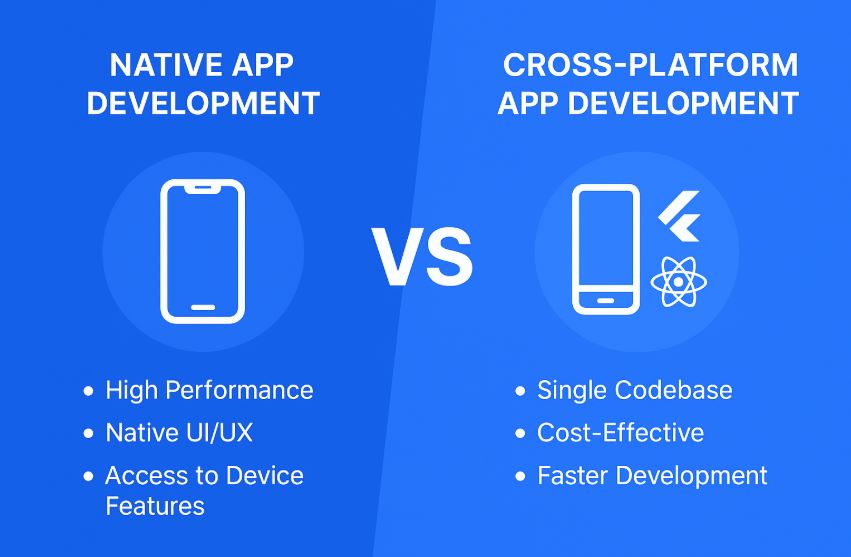
App development has become a key decision point for startups and enterprises. Choosing between native and cross-platform approaches can influence performance, cost, and future scalability. The right choice depends on your project’s needs, target audience, and long-term growth plans. This guide breaks down each approach so you can decide with confidence.
Native app development means building separate apps for each platform like iOS and Android. Each app is written in a language specific to that operating system, such as Swift for iOS or Kotlin for Android. This allows developers to take full advantage of device hardware and OS features. It’s often chosen for apps where performance and user experience are top priorities.
Cross-platform app development allows you to create one codebase that works on multiple platforms. Frameworks like Flutter, React Native, and Xamarin make this possible. It saves time and development costs by reusing most of the code across platforms. However, it may have some limitations in performance and access to certain native features.
Native apps deliver the highest performance because they are optimized for a specific platform. They offer smoother animations, faster load times, and better responsiveness. Access to device-specific features like GPS, camera, and sensors is more seamless. They are also more secure because they follow the native platform’s security protocols.
Building separate apps for each platform can increase development costs. It also requires maintaining two different codebases, which takes more time and resources. Updates need to be rolled out separately for iOS and Android versions. This can slow down release cycles and increase ongoing maintenance costs.
Cross-platform development reduces costs by using a single codebase. It allows faster time-to-market since most of the app logic is shared. Updates and fixes can be applied to all platforms at once. It’s ideal for startups and small businesses that want to launch quickly.
Performance may not be as fast as native apps in heavy-processing scenarios. Some advanced native features may require extra work or custom plugins. The app may not feel fully integrated with the device’s operating system. Complex animations or 3D graphics can be challenging to optimize.
Choose native development if performance and design perfection are your main priorities. It’s also better for apps that require heavy use of hardware features like AR, VR, or advanced sensors. Gaming apps and high-security applications benefit most from native builds. If budget allows, this approach offers the most polished experience.
Choose cross-platform if you want to launch quickly on both iOS and Android with a smaller budget. It’s a great fit for MVPs, startups, and content-based apps. If your app relies more on standard UI elements rather than advanced graphics, it will perform well. This option works best when speed and cost efficiency outweigh minor performance trade-offs.
Native development often costs more due to separate coding for each platform. Cross-platform offers savings by building once and deploying everywhere. However, if your app requires deep integration with the OS, the extra work in cross-platform could reduce cost benefits. Long-term maintenance costs also vary depending on how often you plan to update the app.
Native apps win in raw speed and efficiency, especially for complex features. Cross-platform apps are still fast for most use cases but may lag behind in extreme conditions. For example, a high-end mobile game will run smoother natively. But a business productivity app will work fine in cross-platform frameworks.
Native apps scale well for complex, feature-rich products. They can easily adopt new OS updates and capabilities as they are released. Cross-platform can also scale, but it may require extra work when integrating new platform-specific features. Your growth plans should guide this decision.
Both native and cross-platform app development have unique advantages. Your decision should be based on your app’s complexity, budget, and time-to-market needs. Native works best for performance-driven, complex applications. Cross-platform is perfect for rapid, cost-effective multi-platform launches.